Why Don't We Eat Turkey Eggs? The Real Reason They Aren't in Aisles
In this edition of Fork & Ladle Investigates, we take a deep dive into turkeys eggs and explain why you'll never find them on supermarket shelves.

Want To Save This Recipe?
Tl;DR - Why Don't We Eat Turkey Eggs?
Turkey eggs are perfectly safe to eat and many people actually do. But you'll never find them in grocery stores and the reason is purely financial. Turkeys cost more to raise than chickens and they lay far fewer eggs. At a typical price of $3 to $5 per egg, they're just too expensive to be widely available and will likely remain a specialty item or curiosity.
What Do Turkey Eggs Taste Like?
I've never actually tasted a turkey egg myself, but in researching this article I asked a lot of people who have. The consensus is that turkey eggs are a bit richer and thicker than chicken eggs, but the difference in taste is very subtle. Most people wouldn't be able to tell the difference in a blind taste test.
And that's actually part of the reason why turkey eggs aren't commercially available. Chicken eggs are far easier and cheaper to produce. So if you can't tell the difference between turkey eggs and chicken eggs, why would you want to pay significantly more for a turkey egg?
The Economics of Turkey Eggs
I had a devil of a time trying to find turkey eggs for sale here in New Jersey. While there are a few places that sell turkey eggs for hatching, I couldn't find ANY that have turkey eggs for eating (there were a few places that say to call for turkey egg availability, or to visit their local farmstand). I did find one place in upstate New York, but they were going for $19.79 for a half dozen (that's $3.29 per egg) and they were out of stock.
In other words, turkey eggs are pretty rare. Farmers would rather keep them to hatch turkeys of the future instead of selling them. Here's why:
Chickens have been specifically bred for hundreds of years to maximize egg production. A typical chicken hen lays around five to seven eggs per week. They're basically individual assembly lines that shoot out eggs all year long.
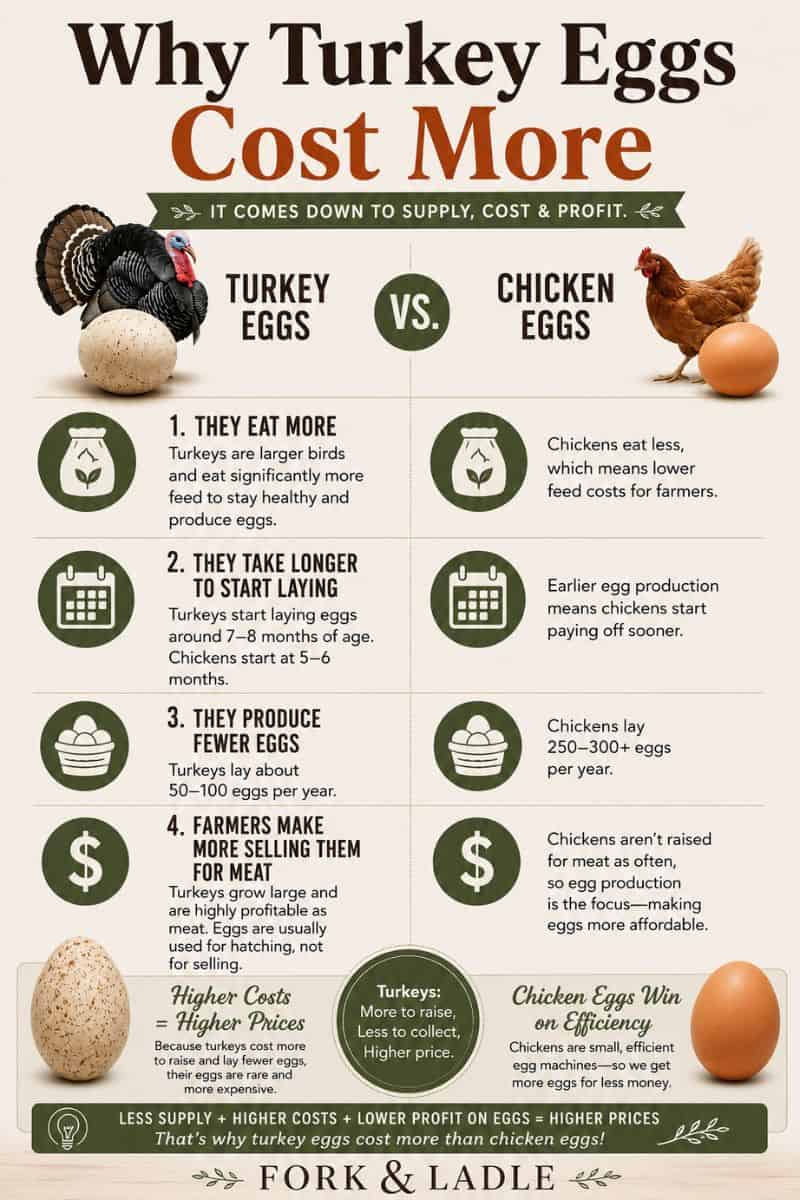
However, turkeys only lay a couple eggs per week and even that is limited to the spring and summer. So while you might get 300 eggs per year from a chicken, a turkey might only give you 50 to 100.
Turkeys also cost more to raise than chickens. They're bigger and take up more space, plus they eat more feed. Plus chickens begin laying eggs at around five or six months old, while turkeys often take seven to eight months to start laying. That means farmers spend more time and money before ever seeing their first turkey egg.
The Bottom Line
By the time a farmer factors in the extra space turkeys require, the three-month delay in laying, the massive grocery bill for feed, and the low annual yield, a single carton of turkey eggs would have to retail for $35 to $50 just to break even. In a world where consumers wince when chicken eggs cross the $4 mark, mass-market turkey eggs are a financial impossibility.