
Pop-Up Turkey Timers Are Liars! Use This Instead…
Trusting pop-up turkey timers can lead to a Thanksgiving disaster. Learn why you should never trust them and how to check your turkey’s temperature the right way.
Want To Save This Recipe?
Nothing says Thanksgiving like a delicious turkey dinner. But did you know that 63 percent of Americans prefer Thanksgiving side dishes to the actual turkey? And 47 percent would be happy to do away with the turkey altogether.
Those statistics shocked me, because I love a good Thanksgiving turkey. But when I really sat and thought about it I realized why so many people are anti-turkey.
It’s because they’ve never actually tasted a well-cooked turkey that wasn’t bone dry.
And I get it. I’ve experienced overcooked turkey too. It’s dry and bland and you can barely swallow it without either dosing it in gravy or washing it down with a glass of wine. But I’ve also tasted turkey that’s tender, juicy, and full of flavor.
The problem is most people are terrible at cooking turkey. Here are my theories why most people are terrible at cooking turkey:
- Unlike most dinners, it’s a big bird that takes hours to cook
- It’s hard to get good at cooking something you only make once a year
- The pop-up timer sets them up to fail
Let me explain…
Pop-Up Turkey Timers Lead To Overcooked Birds
To understand why relying a on pop-up timer is such a bad idea, you have to understand how they work. The timer is really just a very simple thermometer. Inside the outer case is the stick that pops up, a spring, and a piece of soft metal. The metal holds the stick in place until it reaches a certain temperature and begins to melt. When the metal melts, it release the stick and the spring pops it up so you know the turkey is done.
Sounds pretty foolproof right? But there’s a problem…
The metal inside the pop-up timer has a melting point that is way too high. The little button won’t pop up until it reaches a temperature of about 175 F to 180 F and that is WAY overcooked.
If you wait for the timer to pop-up before pulling your turkey out of the oven, you’ve already doomed your family to a bone-dry Thanksgiving turkey.
Don’t believe me? Check out the product description for a pop-up turkey timer that confirms it…
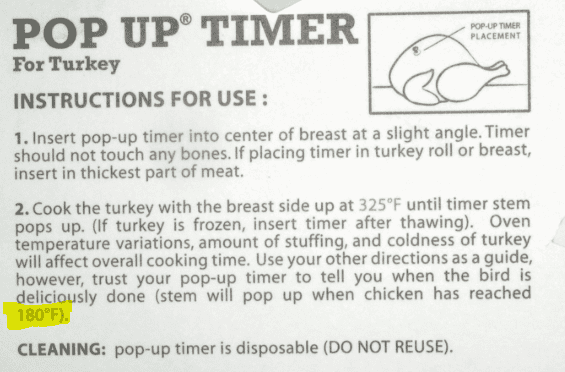
They’re actually telling you that if the product works as designed, your turkey will suck (at least they’re honest!)
And that’s assuming it works correctly. The timer could fail and pop too soon, in which case you’d risk serving your family undercooked turkey. Or sometimes the popper never pops up at all no matter how long it’s in the oven.
At What Temperature Is A Turkey Cooked?
I’m going to be a little controversial here. Most websites and even the USDA will tell you to cook your turkey to 165 F. Frankly, I think that’s bad advice and leads to a whole lot of overcooked turkeys.
I prefer to cook my turkey to 150 F. As you’ll see below, that temperature is completely safe and your guests will wonder how you cooked such an incredibly juicy turkey. There’s no top secret technique…you just didn’t overcook it!
So why do I cook my turkey a full 15 degrees less than the commonly recommended temperature of 165 F?
Here comes the science!
Raw foods (like your Thanksgiving turkey) may contain dangerous pathogens such as Staphylococcus Aureus and Salmonella. Cooking the turkey kills those bacteria and makes the meat safe to eat. The USDA recommends cooking turkey to 165 F because that will kill virtually 100 percent of any bacteria.
If you like to get technical, you can read this very long PDF which will explain that cooking turkey to 165 F will result in a 7-log reduction, which means 99.99999 percent of any bacteria present would be destroyed.
But temperature is only one part of the food safety equation. You also have to consider time.
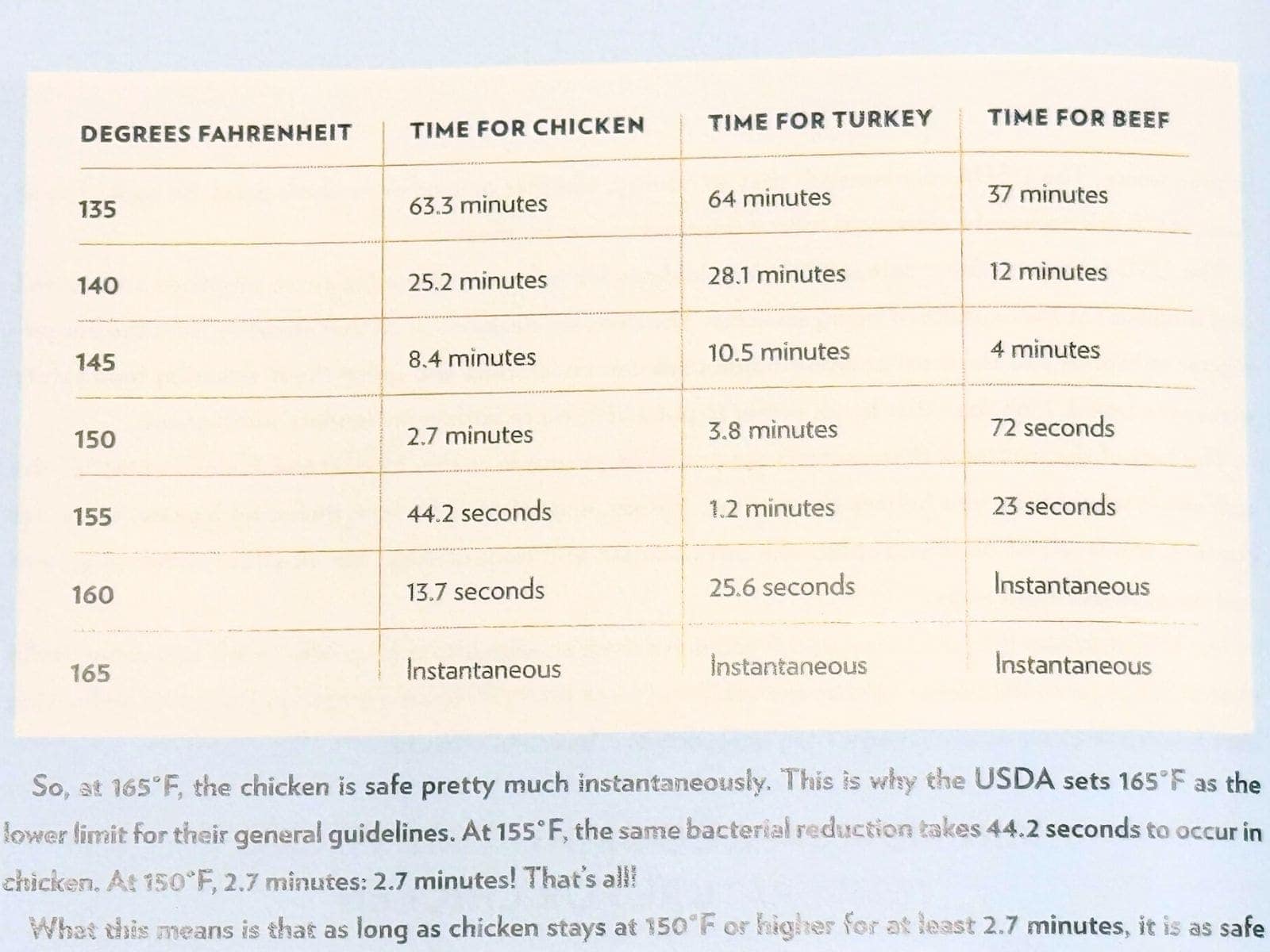
Turkey cooked to 165 F is safe to eat instantaneously. But you can get that same 99.99999 percent reduction in bacteria by cooking it to 155 F for just 1.2 minutes. And 150 F it will be safe to eat after just 3.8 minutes!
In other words, the USDA uses 165 F as a very conservative and easy to remember guideline. But as long as the bird’s internal temperature is maintained at 150 F for about 4 minutes, it’s just as safe to eat.
A big thanks to The Food Lab, an amazing book about the science of cooking. Below is a picture I took from my copy of the book. It shows a simple chart with cooking times for chicken, turkey, and beef at various temperatures.
How To Check A Turkey’s Temp The Right Way
The best way to know for certain that your turkey is fully cooked is to check the temperature with a digital meat thermometer.
A good meat thermometer is way more accurate than a pop-up timer and it will allow you to take your bird’s temperature in multiple places to ensure all parts of the turkey are fully cooked.
This is the instant read food thermometer I use at home. It’s inexpensive and it’s saved my butt numerous times. Don’t cook without it!
The short video below demonstrates exactly where to stick the thermometer to check a turkey’s temperature so there’s no guessing at all.
Sources:
- FSIS Cooking Guideline for Meat and Poultry Products
- US Department of Agriculture
- Centers for Disease Control and Prevention
- The Food Lab by J. Kenji Lopez-Alt